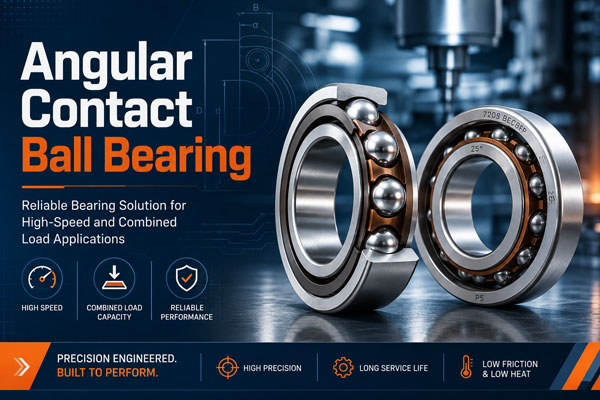
Angular Contact Ball Bearing Guide
Modern industrial machinery often operates at high speeds and carries both radial and axial loads. In such applications, selecting the right bearing is essential for smooth operation, machine accuracy, and long service life. An Angular Contact Ball Bearing is specially designed to handle combined loads while providing stable performance at higher rotational speeds.
These bearings are widely used in machine tools, pumps, electric motors, gearboxes, compressors, automotive systems, and precision industrial equipment.
Shubh Traders provides Angular Contact Ball Bearings for different industrial and engineering requirements. Businesses searching for an Angular Contact Ball Bearing Manufacturer or reliable bearing source should consider bearing size, contact angle, load direction, operating speed, lubrication, and installation conditions before making a purchase.
What Is an Angular Contact Ball Bearing?
An Angular Contact Ball Bearing is a rolling bearing in which the raceways of the inner and outer rings are positioned at an angle to each other.
This design creates a contact angle between the balls and raceways, allowing the bearing to support both:
- Radial loads
- Axial loads
The axial load-carrying capacity generally increases with the contact angle.
Angular Contact Ball Bearings are therefore suitable for applications where radial and thrust forces act on the shaft at the same time.
How Does an Angular Contact Ball Bearing Work?
Inside the bearing, the balls rotate between the inner and outer raceways.
Because the contact points are arranged at an angle, the bearing can transfer loads in both radial and axial directions.
During operation, the bearing helps:
- Reduce friction
- Support rotating shafts
- Maintain shaft position
- Handle combined loads
- Improve rotational stability
- Support high-speed operation
Correct mounting is especially important because many Angular Contact Ball Bearings are designed to support axial load primarily in one direction.
Main Benefits of Angular Contact Ball Bearings
Handles Combined Loads
One of the main advantages of an Angular Contact Ball Bearing is its ability to support radial and axial loads at the same time.
This makes it useful in machinery where forces act in multiple directions.
Suitable for High-Speed Applications
Angular Contact Ball Bearings are commonly selected for high-speed machinery when the correct bearing design, lubrication, preload, and installation conditions are used.
High Axial Load Capacity
The angled raceway design allows the bearing to handle axial loads more effectively than many general-purpose radial ball bearings.
The required contact angle should be selected according to the application’s load conditions.
Accurate Shaft Positioning
Angular Contact Ball Bearings can provide good rotational accuracy and shaft support.
This makes them suitable for precision equipment where shaft movement must be controlled.
Multiple Bearing Arrangements
Angular Contact Ball Bearings can be installed individually or in matched pairs depending on the application.
Common arrangements allow engineers to manage axial forces from different directions.
Compact and Efficient Design
These bearings can handle combined loading in a relatively compact bearing arrangement, helping equipment designers save installation space.
Applications of Angular Contact Ball Bearings
Machine Tools
Precision machine tools require accurate and stable spindle rotation.
Angular Contact Ball Bearings are commonly used in:
- CNC machines
- Milling machines
- Grinding machines
- Lathe spindles
- Machining centres
Their high-speed capability and rotational accuracy make them useful for these applications.
Pumps
Pumps may generate radial loads as well as axial thrust.
Angular Contact Ball Bearings can support pump shafts and help maintain stable rotation under combined loading conditions.
Electric Motors
Certain motor applications require bearings capable of supporting both radial and axial loads.
Proper bearing selection helps improve smooth motor operation and shaft stability.
Compressors
Compressors often operate at relatively high speeds and may generate axial forces.
Angular Contact Ball Bearings can be selected where combined load handling and rotational stability are required.
Gearboxes
Gear systems create forces in different directions.
Angular Contact Ball Bearings can help support gearbox shafts where axial thrust is present.
Automotive Applications
Depending on the system design, Angular Contact Ball Bearings may be used in different automotive and transmission-related applications.
Types of Angular Contact Ball Bearings
Single Row Angular Contact Ball Bearing
A single row Angular Contact Ball Bearing can support combined loads but generally handles axial load mainly in one direction.
It may be paired with another bearing when axial loads act in both directions.
Double Row Angular Contact Ball Bearing
A double row design provides two rows of balls.
It can support radial loads along with axial loads acting in both directions, depending on its design.
Paired Angular Contact Ball Bearings
Two single-row bearings may be mounted together to improve load capacity, rigidity, or axial load handling.
Common arrangements include:
- Back-to-back arrangement
- Face-to-face arrangement
- Tandem arrangement
The appropriate arrangement depends on load direction and required machine rigidity.
Understanding Contact Angle
The contact angle is an important factor when selecting an Angular Contact Ball Bearing.
It represents the angle between the line connecting the contact points of the ball and raceways and the radial plane of the bearing.
In general:
- Smaller contact angles can be suitable for higher-speed applications.
- Larger contact angles can provide greater axial load-carrying capability.
However, actual performance depends on the complete bearing design and operating conditions.
Angular Contact Ball Bearing vs Deep Groove Ball Bearing
Deep Groove Ball Bearing
A Deep Groove Ball Bearing is commonly selected for:
- Mainly radial loads
- Moderate axial loads
- General-purpose applications
- Motors
- Fans
- Pumps
Angular Contact Ball Bearing
An Angular Contact Ball Bearing is more suitable when:
- Higher axial loads are present
- Radial and axial loads act together
- High rotational accuracy is required
- Higher operating speed is involved
- Controlled shaft positioning is important
Industries Using Angular Contact Ball Bearings
- Machine tool industry
- Automotive industry
- Pump industry
- Electric motor industry
- Compressor industry
- Engineering industry
- Manufacturing plants
- Textile machinery
- Packaging machinery
- Precision equipment
- Robotics and automation
- Gearbox applications
- Industrial machinery
The exact bearing design required will vary according to each application.
Angular Contact Ball Bearing for Pumps
Pump shafts can experience both radial forces and axial thrust.
An appropriately selected Angular Contact Ball Bearing can help manage these loads and maintain correct shaft positioning.
Before selecting a bearing for a pump, check:
- Pump speed
- Shaft size
- Radial load
- Axial thrust
- Operating temperature
- Lubrication method
Choosing an Angular Contact Ball Bearing Manufacturer
When searching for an Angular Contact Ball Bearing Manufacturer, buyers should evaluate more than product price.
Important factors include:
- Available bearing sizes
- Contact angle options
- Single and double row designs
- Load capacity
- Speed capability
- Bearing material
- Accuracy requirements
- Technical specifications
- Application support
- Product availability
Understanding the machinery requirement before purchasing can help avoid premature bearing failure.
Conclusion
An Angular Contact Ball Bearing is an effective bearing solution for machinery where radial and axial loads act together. Its angled contact design provides strong axial load handling, good rotational accuracy, high-speed capability, and reliable shaft support.
These bearings are widely used in machine tools, pumps, motors, gearboxes, compressors, automotive equipment, and other precision industrial machinery.
Shubh Traders provides Angular Contact Ball Bearings for different industrial and engineering requirements. Businesses searching for an Angular Contact Ball Bearing Manufacturer or reliable bearing source should select bearings according to dimensions, contact angle, load direction, speed, preload, lubrication, and operating environment.
Choosing the correct bearing can help improve machine performance, reduce premature wear, and support reliable long-term operation.
Frequently Asked Questions
An Angular Contact Ball Bearing is designed with angled contact between the balls and raceways, allowing it to support combined radial and axial loads.
They are commonly used in machine tools, pumps, compressors, motors, gearboxes, automotive equipment, and high-speed industrial machinery.
Yes. Their design makes them particularly suitable for carrying axial loads along with radial loads.
The contact angle is the angle formed by the load transmission line between the balls and raceways relative to the radial plane of the bearing.
Single-row bearings generally support axial load primarily in one direction, while double-row designs can support axial loads in both directions depending on their configuration.
Yes. Correctly selected Angular Contact Ball Bearings are widely used in high-speed applications such as machine tool spindles, motors, and precision machinery.
Paired arrangements can help support axial loads in both directions, increase rigidity, or increase load capacity depending on the configuration.
Common causes include incorrect installation, excessive preload, poor lubrication, contamination, misalignment, and overloading.
Consider bearing dimensions, radial and axial loads, operating speed, contact angle, preload, lubrication, temperature, and machine requirements.
Check product specifications, bearing range, contact angle options, quality consistency, technical knowledge, availability, and suitability for your machinery.